Design Build is a modern construction project delivery method where a single entity provides both design and construction services under one contract. Conversely, Design-Bid-Build separates these phases, requiring the owner to manage distinct contracts with designers and General Contractors. Key differences include single-point accountability, streamlined communication, and faster project completion. Research shows that this unified approach delivers projects 102% faster than traditional methods, reduces cost growth by minimizing change orders, and heavily utilizes Guaranteed Maximum Price (GMP) structures to mitigate financial risks for owners. This approach transforms commercial construction and remodeling globally.
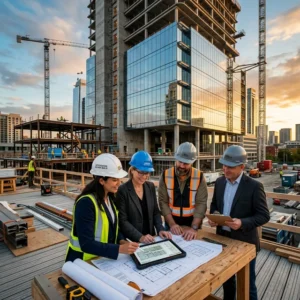
The construction industry is constantly evolving, seeking out better, more efficient ways to deliver high-quality projects. Among the numerous delivery methods available today, one stands out for its ability to unify teams, reduce risks, and accelerate timelines. That method is Design Build.
At its core, it represents a fundamental shift from traditional fragmented processes toward a highly integrated, collaborative approach. But what exactly does it entail, and how does it compare to the well-known, historically dominant methods that have shaped architecture and engineering for centuries? We will explore this question thoroughly to provide you with a comprehensive understanding of how unified models are reshaping development worldwide.
This progressive delivery method simplifies the entire construction journey by offering a single point of responsibility. Instead of the owner juggling separate contracts for architectural design and physical construction, one entity—often a contractor-led or architect-led team—takes full ownership of both phases from inception to completion. This is a game-changer for owners seeking peace of mind.
This streamlined approach means the designers, engineers, estimators, and builders work together as a unified front under one roof or a joint venture. From the moment conceptual drawings begin, the construction team is already providing input on materials, costs, and schedule feasibility. It completely eliminates the adversarial relationship that often develops when designers and builders are siloed in different corporate structures.
In traditional models, an owner hires an architect to draft plans. Once the plans are fully engineered, the owner solicits bids from general contractors. The contractor with the lowest qualified bid wins the job. If the contractor discovers flaws in the blueprints, the owner is caught in the middle of a blame game between the architect and the builder, leading to costly delays and change orders. These disputes can derail even the most well-capitalized developments.
With the unified approach of Design Build, the team works cohesively from day one. Because the builder is involved during the design phase, potential constructability issues are identified and resolved before ground is ever broken. This proactive strategy ensures the final blueprint is not only beautiful and functional but also financially viable and efficient to execute.
Before the widespread adoption of modern integrated methods, the industry relied heavily on Design-Bid-Build. This traditional sequential process has been the standard for public and private projects for decades, and understanding it is crucial to recognizing why alternative methods have gained so much traction. The sequential nature of the process often dictates the exact opposite of collaborative efficiency.
The traditional method is inherently linear. Initially, the project owner selects an architectural and engineering firm based on their qualifications and past portfolio. This firm works closely with the owner to develop complete construction documents, specifications, and a detailed project manual. During this entire phase, the actual builder is completely absent from the conversation, which is a significant drawback.
Once the blueprints are finalized, the owner issues a request for proposals (RFP) or an invitation to bid. General contractors review the massive stack of documents, estimate the costs, and submit their hard bids. The owner evaluates the bids, usually selecting the lowest responsible bidder, and signs a separate contract. Only then does the builder step onto the site to begin physical work.
While this method may seem logical on paper—separating design creativity from construction execution—it creates significant real-world challenges. The most glaring issue is the lack of collaboration. Because the builder is excluded from the conceptualization phase, they cannot provide valuable insights on current material costs, labor availability, or constructability. The architect might define a stunning feature that is wildly expensive or practically impossible to build within the owner's budget.
Furthermore, this structure places immense risk squarely on the project owner. If the construction documents contain errors or omissions, the contractor is entitled to submit change orders for the additional work required to fix the mistakes. The architect points fingers at the contractor's execution, the contractor points at the architect's flawed drawings, and the owner is forced to act as a referee while paying for the resulting overages.
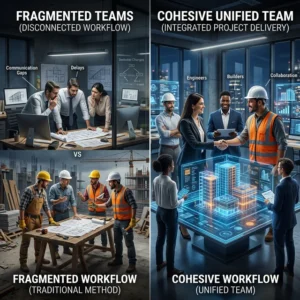
The contrast between these two methodologies is stark, particularly when viewed through the lens of project management. The delivery method chosen sets the tone for communication, contract structures, financial accountability, and the overall pace of the development. Understanding these nuanced differences is essential for making informed procurement decisions.
Perhaps the most significant difference lies in accountability. With Design Build, the owner signs a single contract. If there's an issue with how a structural beam fits into the architectural layout, the owner doesn't need to determine who is at fault. The unified team is entirely responsible for rectifying the problem. This single point of accountability fosters a culture of solutions rather than a culture of blame.
To learn more about the complexities of project execution, check out our guide on collaborating with remodeling contractors.
In traditional sequencing, development cannot begin until the blueprints are completely signed off and the bidding process has concluded. This extends the overall timeline significantly. In contrast, Design Build allows for "fast-tracking." Because the same entity handles both phases, the team can begin procuring materials, securing permits, and even doing site excavation while the final interior design details are still being fleshed out. Fast-tracking shaves months off the project schedule, delivering ROI to the owner much sooner.
Budget overruns are the bane of any project owner. In traditional methods, the true cost is not known until the bids are unsealed—often resulting in "sticker shock" if the architect designed beyond the budget. In the integrated model, the builder provides continuous, real-time cost estimating as the plans evolve. If a proposed element pushes the project over budget, the team immediately pivots to find an alternative, ensuring the final blueprint matches the financial constraints perfectly.
The meteoric rise of the Design Build method is no accident. The industry, particularly in commercial development, infrastructure, and large-scale remodeling, has recognized the undeniable advantages it brings to the table. These advantages go far beyond simple cost savings, touching upon every aspect of the project lifecycle.
Collaboration is not just a buzzword; it is the fundamental engine that drives success in this model. By bringing architects, engineers, and builders to the same table from day one, creative friction is replaced with synergistic innovation. Builders suggest cost-effective materials that achieve the architect's aesthetic vision, and architects adjust their plans to accommodate more efficient construction sequencing.
Risk management is critical in commercial development. As highlighted by DBIA and AIA data, traditional models expose the owner to the "Spearin Doctrine," which generally states that the owner warrants the accuracy and sufficiency of the design plans provided to the contractor. If the plans are flawed, the owner pays the price. Under Design Build, the design and execution risk is successfully shifted away from the owner and entirely onto the unified entity.
Time is money. According to robust research from the Pankow Foundation and the Construction Industry Institute (CII), Design Build projects are delivered 102% faster than traditional projects and 36% faster than Construction Manager at Risk (CMAR) projects. This speed is achieved through fast-tracking, eliminated bidding periods, and a drastic reduction in the time spent arguing over RFIs (Requests for Information) and change orders.
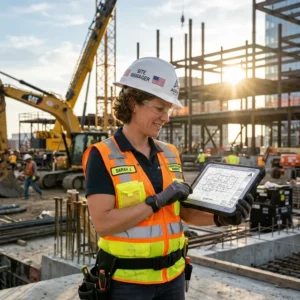
Project success hinges heavily on the role of the Construction Manager (CM). Within the integrated model, the CM is not just a supervisor of fieldwork; they are a critical consultant during the pre-construction and conceptual phases. They provide the necessary reality checks on ambitious aesthetics, ensuring that beautiful concepts are grounded in practical constructability and precise cost metrics.
It's important to distinguish between integrating design with execution and the CMAR method. In CMAR, the owner still holds two separate contracts (one with the architect, one with the CM). The CM provides pre-construction consulting and commits to a Guaranteed Maximum Price (GMP), but the owner remains liable for structural flaws because the architect is contracted directly to the owner.
Alternatively, the integrated Design Build approach wraps everything into one manageable package, completely removing the owner from the middle of disputes. While CMAR is a vast improvement over traditional hard bids, it still lacks the ultimate single-point accountability that the unified method provides.
For deep insights into managing multi-faceted projects, read about our construction management strategies.
The financial structure of a contract fundamentally dictates how risk is shared and how transparency is handled. The two most common financial frameworks are Guaranteed Maximum Price (GMP) and Lump Sum (also known as Stipulated Sum or Hard Bid). Knowing when to use which is an essential skill for any sophisticated owner or developer looking to minimize their exposure.
In a Lump Sum contract, the builder agrees to complete the project for a single, fixed price. If they complete it under budget, they keep the savings as profit. If it goes over budget (excluding owner-directed changes), they absorb the loss. However, this incentivizes the builder to cut corners or fiercely fight for change orders to protect their margins.
The Design Build process thrives on transparency and trust, which is why it frequently utilizes a Guaranteed Maximum Price (GMP) structure. Under a GMP, the unified team commits to a price cap. The financial books are "open," allowing the owner to see all subcontractor bids, material costs, and built-in contingencies. If the project finishes under the GMP, the savings are often shared between the owner and the builder, aligning their incentives to execute the project as efficiently as possible.
Change orders are the dreaded reality of the development world. They occur when there is a deviation from the original contract—due to design errors, unforeseen site conditions, or owner-requested scope changes. In traditional models, change orders are a significant source of friction, litigation, and severe cost overruns because the contractor uses them as a primary mechanism to boost profitability on a tight hard bid.
One of the most heralded benefits of Design Build is its remarkable ability to suppress change orders. Because the builder reviewed and influenced the drawings during the conceptual phase, the risk of "constructability errors" is almost entirely eliminated. Furthermore, if the architectural team makes an error, it is an internal problem for the unified entity to solve; they cannot issue a change order and bill the owner for their own mistake.
The only time a change order typically occurs in this unified model is if the owner explicitly decides to alter the scope of the project (e.g., deciding to add a fourth floor to a three-story building) or if there are completely unforeseeable site conditions (like discovering an unmapped underground utility or hazardous materials). This predictability provides unparalleled financial peace of mind for owners and investors.

As the industry continues to innovate, a nuanced variation known as Progressive execution has emerged, gaining massive popularity particularly in complex infrastructure, water treatment, and major public works sectors, demonstrating incredible flexibility across massive operational paradigms.
In the progressive model, the unified team is selected almost entirely on qualifications rather than a hardened price. This allows the owner to bring the team on board at the absolute earliest conceptual stage. The development then proceeds in two distinct phases that maximize transparency and careful planning at every step.
Phase 1: The team works collaboratively with the owner to develop the blueprints to roughly 60% completion. During this intense collaborative period, they finalize the project scope, conduct detailed value engineering, and lock down major equipment pricing. At the end of Phase 1, the team presents a firm Guaranteed Maximum Price (GMP). This phase acts as a tremendous risk mitigation strategy.
Phase 2: Assuming the owner accepts the GMP, the project moves smoothly into final detailing and execution. Because the owner was intimately involved in every decision leading up to the GMP, there are virtually no surprises, and the risk profile for both parties is extraordinarily low.
No large-scale project operates in a vacuum; it requires a robust legal framework to govern relationships, outline responsibilities, and protect the massive financial investments involved in commercial restructuring and development. These frameworks are continuously tested and refined through decades of litigation and negotiation.
The American Institute of Architects (AIA) and the ConsensusDocs coalition provide the bedrock standard agreements used across North America. Both organizations have developed comprehensive families of documents specifically tailored for the Design Build relationship. These contracts explicitly define the single point of responsibility, clarify the mechanics of the GMP, and outline insurance and bonding requirements unique to this integrated method. Utilizing standard, court-tested documents helps avoid ambiguities that lead to costly litigation down the road.
For more detailed information on contract structuring, owners can reference the comprehensive AIA Contracts portal.
As mentioned earlier, the Spearin Doctrine (from a historic 1918 Supreme Court case) established that owners impliedly warrant the plans they provide to contractors. In traditional bid environments, this is the root cause of countless legal battles over defective drawings. The beauty of the unified method is that it legally transfers this liability away from the owner. Since the owner is not providing the final drawings to the contractor—the unified entity is creating them internally—the owner is insulated from claims arising purely from blueprint defects.
The numbers speak for themselves. According to the 2025 DBIA Data Sourcebook and extensive research from organizations like FMI, the integrated sector is projected to hit staggering heights, representing over $2.6 trillion in development spending in the coming years. This is not a niche delivery method; it is rapidly becoming the dominant force in the industry.
This explosive growth is fueled by data-backed performance metrics. Across almost every measurable category—cost growth, schedule predictability, speed to market, and owner satisfaction—the integrated approach massively outperforms the traditional fragmented models. Whether it is a multi-million dollar stadium, a complex highway interchange, or a state-of-the-art medical facility, owners have realized there are trillions of reasons to build smarter, faster, and more collaboratively.
Navigating the labyrinth of local building codes and stringent state regulations—particularly in highly regulated markets like California—is a daunting task for any owner. Traditional models often see blueprints rejected at the permit office because the architect, isolated from current field realities or local inspector quirks, proposed something non-compliant or prohibitively difficult to approve.
In the unified model, the team often includes embedded permitting specialists and seasoned field superintendents who interact with local jurisdictions daily. They ensure the blueprint is heavily vetted against local zoning laws, energy codes, and safety regulations long before it hits the city planner's desk. This proactive regulatory management prevents months of devastating delays trapped in the bureaucratic cycle of resubmissions.
As the global push for sustainable architecture and LEED certification intensifies, delivery methods must adapt to accommodate complex environmental systems. Green features require a holistic approach; a high-efficiency HVAC system cannot be realized in a vacuum without considering the structure envelope, solar orientation, and material sourcing.
The traditional fragmented approach struggles with this holistic necessity, often resulting in disjointed systems that fail to meet targeted energy metrics. Conversely, this progressive method was virtually made for sustainable development. Architects and mechanical integrators sit in the same room, modeling energy usage in real-time. If the architect proposes expansive glass facades, the mechanical engineer immediately calculates the required cooling load, allowing the team to instantly pivot to higher-efficiency glazing or superior shading structures to maintain environmental goals without breaking the budget.
For more on integrating sustainable features into large residential and commercial properties, explore our deep dive into project planning for the future.
Safety is the uncompromisable priority on any site. Poor structural conceptualization can inadvertently create incredibly dangerous conditions for the men and women swinging hammers and operating heavy machinery. When an architect dictates a visually stunning but structurally complex overhang without consulting a supervisor on how to actually erect it, they introduce severe scaffolding and fall-risk hazards.
Because the unified team forces early collaboration, constructability is analyzed through a strict safety lens before blueprints are finalized. Field operations managers can demand structural modifications—such as shifting a welded connection point—simply because it is safer to assemble on the ground rather than 50 feet in the air. This pre-planning translates directly to lower incident rates, reduced insurance premiums, and a healthier, more confident workforce.

The modern field is a digital landscape. Building Information Modeling (BIM), 3D scanning, and virtual reality have revolutionized how structures are envisioned and realized. However, the true power of these digital tools is severely kneecapped in traditional sequential workflows where models are legally guarded and not fully shared due to liability concerns.
Under the unified banner of collaborative teams, technology flourishes. A single, centralized BIM model is maintained and utilized by everyone from the lead architectural creator to the drywall subcontractor. This shared digital twin allows for "clash detection"—identifying where a plumbing pipe intersects a steel beam in the digital realm before the pipe is ever fabricated in the real world. This seamless integration of technology drastically reduces material waste and field rework, significantly boosting the bottom line.
While the advantages are overwhelmingly positive, no project delivery method is completely flawless. One of the common critiques of unified delivery is the perceived lack of checks and balances. In traditional models, the architect theoretically acts as the owner's independent watchdog over the contractor. In the unified model, because the architect and contractor are on the same team, some owners fear they might collude to cut corners.
However, this fear is mitigated through rigorous pre-qualification, strict adherence to the GMP financial transparency, and often the hiring of an independent Owner's Representative. Furthermore, sophisticated owners realize that the benefits of eliminating the adversarial architect-versus-contractor relationship far outweigh the theoretical loss of an independent watchdog. Trust, verified through open-book accounting, becomes the ultimate check and balance.
Another profound shift occurs in the realm of owner involvement. Traditional models often leave the owner in the dark for months during the conceptual phase, only to overwhelm them with massive blueprint sets right before bidding. This leads to rushed approvals and later regrets.
The new unified methodology demands continuous, structured engagement from the owner. Because decisions on cost and aesthetics are made concurrently, the owner is brought into the process at regular intervals for "over-the-shoulder" reviews. This collaborative journey ensures the owner profoundly understands the tradeoffs being made, empowering them to make highly educated decisions regarding finishes, structural systems, and lifecycle costs. It transforms the owner from a passive check-writer into an active, informed partner in the project's success.

The entire success of this delivery method rests heavily on selecting the absolute best team for the job. Because you are hiring a single entity to execute both massive phases of your project, the qualification process must be incredibly stringent.
Owners should evaluate potential teams based on their historical synergy—have this architect and supervisor successfully completed projects together before? Have they successfully managed Guaranteed Maximum Price contracts? Do they utilize advanced BIM technology collaboratively? Checking references, reviewing past financial performance, and assessing their cultural fit with the owner's organization are non-negotiable steps. A highly competent, cohesive team is an unstoppable force of efficiency; a dysfunctional one can create massive headaches.
Looking ahead, the trajectory is pointing sharply toward further integration and specialized, progressive iterations. We are beginning to see the rise of DBOM contracts, where the team not only erects the facility but takes responsibility for its operational efficiency and maintenance for years after completion. This aligns incentives perfectly, ensuring the team installs the highest quality, longest-lasting equipment because they will be financially responsible for servicing it.
Furthermore, as public legislation continues to ease restrictions that historically mandated traditional low-bid procurement for government projects, we will see an even larger tsunami of public infrastructure, schools, and municipal buildings utilizing the single-point accountability method to stretch taxpayer dollars further than ever before.
Effective communication is the lifeblood of any significant development. When numerous subcontractors, specialized engineers, city planners, and financial stakeholders are involved, the potential for miscommunication grows exponentially. The traditional siloed method often relies on formal, slow-moving RFIs (Requests for Information) that can halt progress for weeks.
In stark contrast, the integrated Design Build environment thrives on instantaneous, multi-disciplinary communication. Teams are often co-located, either physically or virtually, utilizing cutting-edge project management software that provides real-time updates to all parties. If a structural modification is required, the superintendent can directly consult the structural engineer on the same day, immediately updating the shared BIM model and adjusting the procurement schedule without the delays inherent in fragmented systems.
Another powerful advantage of this integrated approach is the ability to onboard critical specialty trade partners—such as mechanical, electrical, and plumbing (MEP) subcontractors—extremely early in the process. In traditional delivery, these subcontractors are brought on last, often forced to work around an architectural vision that didn't fully account for massive ductwork or major electrical conduits.
By integrating these MEP experts during the conceptualization phase, the entire team benefits from their specialized knowledge. They can optimize route planning for utilities, suggest energy-efficient system alternatives, and provide highly accurate cost estimates before any concrete is poured. This early involvement eliminates countless field conflicts and drastically improves the overall efficiency and functionality of the finished structure.
As construction projects grow more complex, more technologically advanced, and more financially demanding, the old ways of fragmented communication and adversarial contracting no longer suffice. By completely aligning the goals of the architects, engineers, estimators, and builders into a single, cohesive unit, the industry is providing owners with what they truly want: predictability and reliability across the entire lifecycle.
Design Build delivers superior cost control, radically faster schedules, drastically reduced change orders, and a significantly less stressful experience for the project owner. The $2.6 trillion projected data proves that the future of successful commercial development and massive remodeling projects lies squarely in the power of integrated, collaborative project delivery.
What is the primary difference between Design Build and Design-Bid-Build?
The primary difference is accountability and timing. The unified approach uses a single contract for both phases, allowing them to overlap (fast-tracking). The traditional approach uses separate contracts and sequential phases.
Does this method restrict the owner's creative freedom?
No, it actually enhances it. By analyzing costs concurrently with aesthetics, owners can make immediate, informed aesthetic choices without the fear of blowing the budget later.
Who carries the risk in these projects?
The vast majority of blueprint flaw and constructability risk is legally shifted away from the owner and placed entirely on the unified entity.
How are change orders handled in this collaborative method?
Change orders are virtually eliminated for blueprint errors or constructability issues. They are typically only issued if the owner explicitly requests a change in the overall project scope or if unforeseen site conditions arise.
Is this method suitable for small remodeling projects?
Absolutely. While highly popular in massive commercial infrastructure, the principles of single-point accountability and unified communication are exceptionally beneficial for residential and small commercial remodeling as well.
Beyond Builder Los Angeles SoCal is a premier construction and remodeling company proudly serving homeowners and businesses across the Greater Los Angeles and Southern California region. We specialize in home remodeling, commercial build outs, room additions, kitchen and bathroom renovations, custom construction, and full restoration services.
With a highly skilled team committed to superior craftsmanship, transparent communication, and timely project delivery, Beyond Builder Los Angeles SoCal provides reliable, high quality construction solutions tailored to your vision. Whether you're planning a full home remodel, expanding your living space, or upgrading a commercial property, we ensure exceptional results from concept to completion.